Cumulative Protection of Creativity: The Fine Line Between Design and Work


Introduction
Intellectual property law provides for various protection mechanisms aimed at safeguarding creative works; such that, depending on the nature of the product or creative works, it is possible to apply for more than one means of protection simultaneously. In this context, designs that meet the necessary criteria may be protected by both design rights under the Industrial Property Code No. 6769 (“IP Code”) and as work under the Law on Intellectual and Artistic Works No. 5846 (“LIAW”).
Under Article 55/1-a of the IP Code, “design” refers to the appearance of the whole or a part of a product resulting from the features of, the line, contour, colour, shape, material or texture of the product itself or its ornamentation. In order to be able to register a design, it must meet the conditions of “novelty” and “distinctive character”, as set out in Article 56 of the IP Code. Design are patterns and ornamentations of aesthetic appeal on all kinds of products or parts of products we encounter in all areas of our daily lives1.
Furthermore; pursuant to Article 1/B-a of the LIAW, a “work” is defined as any intellectual or artistic creation product bearing characteristic of its author and which is deemed to be a work of scientific, literary, musical, fine art or cinematographic nature. In this context, a design may also enjoy copyright protection as “works of art” (Article 4 of the LIAW) to the extent that it possesses aesthetic value and reflects the author’s individual creativity.
Accordingly, creative works may be protected both as an industrial right (i.e. a design right) under the IP Code and also, where it qualifies as a work, as copyright under the LIAW. This situation offers rights holders the opportunity to act under two distinct legal protection regimes, thereby providing more effective defence against infringements. However, the fundamental differences between the two protection regimes and their consequences in praxisa give rise to debates, particularly regarding the extent to which a design may be recognised as a work.
This article will examine in detail the intersection between design and copyright protection; it will assess current practices and the arising legal issues in the light of court rulings regarding the possible forms of protection being granted for the same creative work.
I) Addressing creative work within the framework of Copyright Law:
As mentioned, copyright is protected under the LaLIAW. Pursuant to Article 1/B-a of the LIAW, work is defined as any (iii) intellectual or artistic creation which (i) bears the distinctive character of its author and (ii) is recognised as a work of science, literature, music, the fine arts or cinematography.
Creations that meet this criterion are recognised as work and are entitled to copyright protection from the moment they are created, without the need for any registration procedure. Therefore, for a design to be eligible for copyright protection, it must satisfy the conditions set out above.
When the characteristics of the creative work is examined, the following must be the case:
- There must be an intellectual product. What is meant by “intellectual product” is that it must be the product or result of a mental effort of a natural person; in other words, the product of an individual’s intellectual endeavour.
- This intellectual product must take the form of a tangible device. In other words, it is not sufficient for it to be the product or result of an individual’s intellectual endeavour; the result or product of this intellectual endeavour must be disclosed to the external public, and the idea must be expressed or fixed on a tangible device.
- This intellectual product must bear the distinctive character of its author. By this, what is meant is that the intellectual product bearing the distinctive character of its owner is that it must be original and reflect the unique or distinctive character of its author.
- It must fall within one of the categories of work defined in the LIAW (scientific and literary works, musical works, works of fine art or cinematographic works).
It is also necessary to discuss works of science and literature, as well as works of fine art, under this heading.
Article 2 of the LIAW lists works of science and literature as such:
- Computer programs expressed in any form together with their preparatory designs, provided that the same leads to a computer program at the next stage;
- All kinds of dances, written choreographic works, pandomime and similar theatrical works without dialogue;
- All kinds of technical and scientific photographic works, all kinds of maps, plans, projects, sketches, drawings, geographical or topographical models and similar works, all kinds of architectural and urban designs and projects, architectural models, industrial, environmental and theatrical designs and projects, lacking in aesthetic quality.
As regards works of fine art among the categories of works, these are listed in Article 4 of the LIAW. Accordingly, works possessing aesthetic value include: 1. Oil paintings or water colors, all types of drawings, patterns, pastels, engravings, artistic scripts and gildings, works drawn or fixed on metal, stone, wood or other material by engraving, carving, ornamental inlay or similar methods, calligraphy, silk screen printing; 2. Sculptures, reliefs and carvings; 3. Architectural works; 4. Handicraft and minor works of art, miniatures and works of ornamentation, textiles, fashion designs; 5. Photographic works and slides; 6. Graphic works; 7. Cartoons; 8. All kinds of personifications.2
II) Discussion on creative works within the framework of design law:
Article 56 of the IP Code, under the heading “Novelty and Distinctive Character”, rules that, “Design shall be protected by this Code provided that it is novel and has a distinctivecharacter.” Thus, in order for a design to be protected, it must be (i) novel and (ii) have distinctive character.
Under the IP Code, the criterion of novelty is defined as such: “If an identical design isn’t presented to the public in any part of the world (i) before application or priority date for the registered design, (ii) before the design is presented to the public for the first time for non-registered design it shall be accepted as a new design. If the design differs only in immaterial details, it shall also be accepted as identical.”
Regarding the criteria of disctinctiveness, the IP Code rules that, “If overall impression created by a design on the informed user differs from overall impression created by any design presented to the public on the same user a) before application or priority date for the registered design or b) before the design is presented to the public for the first time for non-registered design, it shall be accepted that this design has a distinctive character. In assessing distinctiveness, the degree of freedom of choice the designer had in developing the design is taken into account.”
III) Assessment of a creative work with respect to copyright and design law:
We have previously discussed how work’s originality implies that it bears the distinctive character of its author, reflects the author’s spirit, and does not merely repeat what is already known. The Court of Cassation, defines the concept of “distinctive character” through concepts such as originality, not being copied from another, novelty, uniqueness, and the creative nature of the work. In this context, it can be stated that the requirement for a work to bear the author’s distinctive character corresponds to the element of “novelty”, which is one of the fundamental criteria that a design right must fulfil.3
Works that may fall within one of the categories defined under the LIAW and which may also be classified as designs are the works of science and literature, as well as works of fine art, as defined above and regulated in Articles 2 and 4 of the LIAW. However, it must be emphasised that the condition of possessing aesthetic value is a key criterion under Article 4. This condition acts as a limiting criterion in terms of the scope of protection, insofar as it determines whether designs are eligible for copyright protection under the LIAW.4
On the other hand, the fact that a work is also used as a design does not negate its status as a work of literature or art.5
Article 58/3 of the IP Code provides that a design protected under the provisions of the IP Code shall also be protected under the LIAW provided it meets the conditions set out therein6. Indeed, there are cases where a design may be protected cumulatively under both design rights and copyright, and there are court rulings addressing this cumulative protection.
IV) Court rulings concerning the cumulative protection of works pursuant to copyright law and design law:
i) Turkish Court Rulings:
Turkish court rulings with regard to the cumulative protection afforded by copyright and design law will firstly be discussed.
The decision of the Istanbul 4th Civil Court for Intellectual and Industrial Property Rights (“IP Court”) dated May 08, 2012 with the merits no. 2010/55 and decision no. 2012/113 is an example of where cumulative protection is the case. In the case in question, the owner of a registered key ring design claimed that the defendant had manufactured and sold key rings that were almost identical to their registered design, and sought a determination of design infringement and copyright infringement, as well as an award of pecuniary and non-pecuniary damages. The court noted that the plaintiff’s registered design constituted a work of fine art in accordance with the LIAW and concluded that the defendant’s acts not only constituted an infringement of the plaintiff’s design rights under design law, but also infringed the plaintiff’s economic and non-pecuniary rights as the author of the work pursuant to the LIAW.7
|
Decision of the Istanbul 4th IP Court dated May 08, 2012 with the merits no. 2010/55 and decision no. 2012/113 |
|
|
The plaintiff’s designs recognised as works: |
|
 |
 |
In a separate case; in its decision dated October 26, 2010 with the merits no. 2009/191 and decision no. 2010/258, the Ankara 3rd IP Court ruled that the unauthorised use of Disney’s copyrighted registered Mickey Mouse character on slippers design was an infringement of the copyright of the registered trademark and ruled that it is not possible to register the contested design in scope of the design law.8
In regard to rulings of the Court of Cassation; the decision of the 11th Civil Chamber of the Court of Cassation dated December 14, 2005 with the merits no. 2004/14760 –and decision no. 2005/12302 the following was the case:
- The plaintiff alleged that their design rights had been infringed, that the defendant’s actions also constituted unfair competition, and that the textile and fashion designs as subject of the case were also work and should therefore be protected under the LIAW; however, the local court ruled that the case had become moot following the cancellation of the relevant design registration.
- The Court of Cassation, although did not make an assessment within the context of the LIAW, it overturned the local court’s decision on the grounds that unregistered designs are also protected under general provisions, that the provisions on unfair competition are applied cumulatively alongside provisions of intellectual property law, and that the local court should have reached a decision by making this legal assessment of its own accord, by assessing whether the conditions for unfair competition had been met.
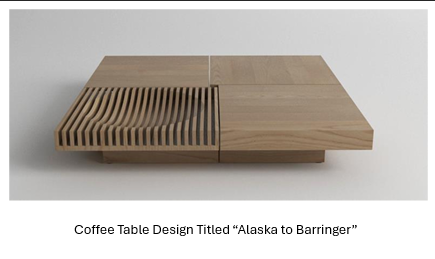
In another example, the 11th Civil Chamber of the Court of Cassation with the merits no. 2005/3153 and decision no. 2006/5491 ruled that a coffee table design is accepted as a work of fine art. In the ruling, the coffee table entitled “Alaska To Baringer”, designed by Atilla Kuzu in 2002, was characterised as “the work forming the subject of the plaintiff’s original design” and recognised the work to be within the scope of copyright protection.9 Although the ruling does not explicitly state what kind of aesthetic value the design possesses or the criteria used to determine this value, it is noted that the term “original” used in relation to the design implies “uniqueness/distinctiveness” and is a criterion frequently considered by the Court of Cassation when defining aesthetic value.
 In another ruling, the Court of Cassation recognised wall-hanging plates and wine bottle designs as works of art. In this case, the subject wall-hanging plates and wine bottles featured fairy chimney ornamentation. It is not clear from the ruling what kind of aesthetic value these designs possess.10
Nevertheless, it is evident that the designs of the wall-hanging plates and wine bottles were considered to be possessing the characteristics of work and are therefore entitled to copyright protection.
Similarly, in another ruling regarding a dispute of the 11th Chamber of the Court of Cassation dated February 13, 2006 with the merits no. 2005/1350 and decision no. 2006/1378, it was concluded that, in addition to indicating that a design may enjoy copyright protection, the wavey form design on the packaging of a chocolate product could not be considered a work as it did not carry aesthetic value. With this ruling, the Court of Cassation has deemed the existence of aesthetic value to be an essential element for designs to qualify for copyright protection; it has thus concluded that designs of a purely functional or ordinary nature cannot be regarded as work.
A review of more recent court rulings reveals that the same principle is upheld and that, for a product to enjoy cumulative protection, an examination is carried out to determine whether it meets the necessary criteria to qualify as both a design under the IP Code and a work pursuant to the LIAW.
Indeed, in the decision regarding the case with the merits no. 2018/182, decision no. 2023/51 and dated February 28, 2023 before the Istanbul 1st IP Court, it was alleged that the plaintiff’s work bearing the expression “...” had been used without authorisation by the defendant’s work bearing the expression “...”, the Court held that “the category referred to as ‘scientific and literary works’ in Article 2 of the LIAW encompasses works expressed in any form of a language, in any language and presented by any means of expression (words, writing, numbers, devices, lines or symbols); both books at issue in the case must therefore be regarded as works; furthermore, the page layout used in the plaintiff’s book and that in the defendant’s book are similar in terms of the dimensions, proportions and relationships of their elements to one another and to the design as a whole, and there are no significant differences in the overall impression created by the designs on an informed user”, and consequently, compensation was awarded pursuant to both the IP Code and the LIAW.
Another similar ruling was rendered by the Istanbul Anadolu 1st IP Court with the merits no. 2022/279, decision no. 2024/113 and dated April 25, 2024, where the plaintiff claimed that the defendant had used the plaintiff’s stand design without authorisation and, in addition to the infringement of the plaintiff’s rights arising from an unregistered design under the IP Code, argued that the stand project in question was also a work bearing the plaintiff’s distinctive character. Whilst the Court noted that the fact that a product constitutes a design within the meaning of the IP Code does not affect its status as a work, it ruled that, given that the design in question was a stand project that could be drawn by anyone possessing a certain level of technical knowledge and did not bear the distinctive character of its author, it did not constitute a work within the meaning of the LIAW.
In a separate dispute; the decision of the 44th Chamber of the Istanbul Regional Court of Appeal (“RCA”) with the merits no. 2023/276, decision no. 2025/905 K. and dated June 19, 2025, the defendant company unlawfully copied seven works belonging to the plaintiff without the plaintiff’s permission, used them in textile products and offered these products for sale online; it was alleged that the designs belonging to the plaintiff, which formed the basis of the case and were claimed to have been copied by the defendant, constituted both “work” under the LIAW and “design” under the IP Code. The RCA stated that “…it is understood that the graphic design in question, bearing the expression “…”, possesses aesthetic and original qualities; therefore, it may be protected as a work of fine art in accordance with Article 4/6 of the LIAW, and simultaneously as an industrial design and advertising text under Article 2/3 of the same Law”. In other words, the RCA accepted that the designs in question also possess the status of a work and are eligible for protection under copyright law.
However, as the plaintiff was unable to prove that they were the author of the work in question, the claim was dismissed.
ii) International Court Rulings
In addition to the Turkish court rulings, it is important to also examine international court rulings, particularly rulings from the European Union and the United States, relating to the cumulative protection of copyright and design law.
In this context, an examination of European Union case-law reveals that, for the most part, criteria similar to those adopted in Türkiye judicial decisions have been applied and similar conclusions have been reached. For example, the ruling of the Court of Justice of the European Union (CJEU) in the case of Cofemel – Sociedade de Vestuário SA v. G-Star Raw CV (C-683/17) is regarded as the most significant and authoritative ruling setting out the principles on this matter.11 In summary, the CJEU ruled that the sole condition for a design to be eligible for copyright protection is “distinctiveness/originality”. This ruling is of great importance as it constitutes the most comprehensive and precedence on the subject. For this reason, the details of this ruling and the background of the dispute will be discussed in a little more detail. To elaborate, in 2013, G-Star, engaged in the manufacture and sale of clothing, brought action against Cofemel in Portugal, operating in the same sector, alleging copyright infringement in relation to certain clothing items. G-Star argued that the designs of its jeans and t-shirts, titled “ARC” and “ROWDY”, constituted original intellectual creations and should therefore be classified as “work” and entitled to copyright protection. In response, Cofemel defended that the products in question did not qualify as “work” and were therefore not eligible for copyright protection.
The case was subsequently referred to the Court of Justice, where the question was raised as to whether it was compatible with EU law for functional designs intended for practical use (such as clothing designs), to be granted copyright protection on the grounds that they possess aesthetic appearance.
The following was emphasised in the relevant ruling of the CJEU:
- There is no need to set a higher threshold of originality for designs to be protected under copyright;
- However, regardless of their intended use, the mere fact that such designs possess aesthetic value is not a sufficient criterion for them to be classified as works under copyright;
- The assessment of aesthetic beauty is based on subjective appreciation/taste and does not satisfy the criterion of reflecting the author’s individuality;
- Design protection covers functional designs suitable for mass production, whilst copyright protection covers designs that qualify as works; in this context, the two types of protection serve different purposes.
From this perspective, this states that, in order to ensure that the purpose and effectiveness is not lost in regard to two types of protection, cumulative protection should only be used in specific circumstances.
As the scope of the concept of “work” is not explicitly defined in EU legislation, the CJEU has brought its own legal assessment and, in this ruling, has systematically explained the criteria necessary for designs to be eligible for copyright protection. As a general rule, designs are not assessed in the same way as works protected by copyright. However, European Union legislation has adopted a system whereby design protection and copyright protection are not mutually exclusive; in other words, they may be applied cumulatively. Therefore, if a design fulfils the two conditions set out above (i.e. the existence of an original object (creation) and that it constitutes an expression of intellectual creation), it may be recognised as a “work” within the meaning of the Directive and become protected by copyrights.12
|
Cofemel – Sociedade de Vestuário SA v G-Star Raw CV C 683/17 |
 |
On the other hand; in its recent judgment of December 04, 2025 in the joined cases of Mio (C‑580/23) and Konektra (C‑795/23), the CJEU referred to the aforementioned Cofemel decision dated September 12, 2019 (C‑683/17, EU:C:2019:721), noting that although the Cofemel ruling held that design protection and copyright protection could be granted simultaneously, and stated that such cumulative protection could only apply in exceptional circumstances.
In the first case, the plaintiff alleged that the copyrights in the “Mio” furniture design had been infringed. The defendant, however, argued that the plaintiff’s furniture designs are not sufficiently unique to qualify for copyright protection. The Court of First Instance found the plaintiff’s claims justified, ruling that the plaintiff’s tables were protected by copyright as works of functional art and that the defendant’s products in question constituted an infringement of that copyright.
In the second case, the plaintiff, “USM” ioperating on furniture systems, whilst the defendant, Konektra, supplies spare parts compatible with USM’s products. In this dispute, USM claimed that Konektra does not merely supply spare parts, but also offers furniture systems that infringe USM’s furniture systems, and that this constitutes an infringement of the copyright protected as a functional works of art. The Court of First Instance accepted the plaintiff’s claims.
|
|
|
|
|
Image of Table from Asplund’s Palais Royal Series13 |
Image of Table from Mio’s Cord Furniture Series14 |
|


Following these decisions, the parties caaried the dispute to the Higher Court. The Higher Court, in turn, decided to stay proceedings and refer the case to the CJEU.
By addressing the conditions and differences in the protection of copyright and design rights, the CJEU ruled that it would not be appropriate to grant copyright protection to a creative work protected as a design, given its different function and characteristics. The CJEU highlighted the following differences: the purpose of design protection is to protect novel products that is suitable for mass production; this protection is limited in duration, and thereby competition is not restricted to a high extent. Protection under copyright, on the other hand, is limited to that which qualifies as works, and its duration of proptection is longer than that of design protection.
In conclusion, the CJEU has held that, when determining whether there has been an infringement of copyright, a comparison of the overall impression of the two works cannot be decisive, as this criterion relates to design protection; rather, in order to establish copyright infringement, it is necessary to examine which original elements have been used without authorisation and whether the copyright-protected element appears in a recognisable form in the new work.
In regard to the rulings in the USA, the first concept that comes to mind when discussing the copyright protection of designs is the doctrine of “useful article” doctrine. The case of Star Athletica v. Varsity Brands is a ruling that played a significant role in the development of the doctrince of “useful article”, which holds a significant place in the legal protection of fashion designs.16
According to US case-law, a useful article is only eligible for copyright protection if it possesses an aesthetic element and that aesthetic element is separable from the functional (useful) aspects of the object. This is because, under US Intellectual Property Law, a useful article falls within the scope of utility model or patent protection.17 In other words, a useful article may be protected under copyright law as a work of art, such as a painting, graphic work or sculpture, provided it possesses an aesthetic element that is physically or conceptually separable.
In the case of Varsity Brands, Inc. (“Varsity”) v Star Athletica, LLC (“Star”), the US Supreme Court rendered an important ruling on whether a specific feature of a “useful article” is eligible for copyright protection.
The dispute arose after Varsity obtained copyright registration for two-dimensional drawings of its designs, which bore a strong resemblance to those of Star. Varsity Brands alleged that Star Athletica’s cheerleader outfits bore similarities to its own designs and claimed that the cheerleader uniform in question was subject to copyright. In its defence, Star Athletica argued that the lines, stripes and design of the cheerleader outfits did not serve an independent creative function, and that these lines, stripes and design served an “informative” function. In other words, it was argued that the elements claimed to be subject to copyright were those indicating that the garment was a cheerleader uniform and that they did not possess any aesthetic value independent of this.18
The First Instance Court held that the designs in question were integral to the functionality of the uniform and could not therefore be subject to copyright protection; the First Instance Court’s decision was subsequently overturned by the US Court of Appeal.
The High Court focused on whether the lines, stripes and coloured patterns on the cheerleaders’ uniforms could be considered subject to copyright, and what factors should be taken into account when deciding whether pictorial, graphic or sculptural design elements should be protected by copyright. In light of these questions, the Court established the doctrine of “useful article” in its ruling. A “useful article” is a design that serves a structurally useful function; the doctrine emphasises that, for such a design to be protected under copyright law, the elements providing the utility must be separable from the aesthetic elements. Furthermore, when ruling on this matter, two fundamental questions must be answered. In regard to the element claimed to be subject to copyright:
- Can it be perceived as a two- or three-dimensional work of art independent of the “useful article”?
- If it can be considered independently of the design combined with the “useful article”, can it be classified as a pictorial, graphic or sculptural design that is eligible for protection, either on its own or when attached to another tangible medium of expression?
|
With this ruling, the Court established an important precedent to the effect that aesthetic elements of a useful article may be eligible for copyright protection, even if they are not entirely independent of the functional element. However, in a dissenting opinion, Justice Ruth Bader Ginsburg argued that the aforementioned separability analysis was unnecessary. According to Ginsburg, as the designs in question are already clearly pictorial, graphic or sculptural works, they should be assessed directly within the scope of copyright protection19. Star Athletica, LLC v. Varsity Brands, Inc. |

In the image above, the design subject to copyright is on the left (black and white), whilst the design alleged to infringe that copyright is on the right (blue and red). |

In fact, there are court rulings dating back to many years before the doctrine of “useful article” was established in the US, which recognised that copyright and design rights were protected cumulatively. Indeed, in the Kieselstein v. Cord case heard in 1980, a trademark producing jewellery, belt buckles and leather goods brought a claim on the grounds that the design of its belt buckle had been copied exactly; in its ruling, the Federal Court concluded that the belt buckle design could be separated from the design as a whole and was therefore eligible for copyright protection. In this scope, only the belt buckle was granted copyright protection, whilst the remaining elements of the belt were excluded from the scope of protection.

V) Conclusion
The overlap between design law (protection under the IP Code) and copyright law (protection under the LIAW) enables cumulative protection depending on the nature of the works, thereby offering right holders a robust and flexible foundation of protection. A design may be protected under the IP Code provided it meets the conditions of novelty and distinctiveness; it may be protected under copyright law if it reflects the author’s individuality and falls within one of the categories of works set out in the LIAW. Thus, a single creation may give rise to rights both as a registered or unregistered design and as “work”.
Case-law demonstrates that this dual protection is recognised in accordance with the circumstances of the specific case: Turkish courts have, on occasion, classified designs characterised by aesthetic value and originality as “works of fine art”; in some cases, they have found copyright infringement in addition to design infringement. On the other hand, it has been emphasised that designs lacking aesthetic value or containing purely functional elements do not fall within the scope of copyright protection. Whilst the EU Cofemel ruling is based on the “originality/distinctiveness” criterion, the Star Athletica precedent in the US, adopting the “useful article” approach, has recognised that aesthetic elements separable from functional elements are eligible for copyright protection. This overview demonstrates that the criteria of “creative contribution/originality/distinctiveness” and “aesthetic expression separable from the functional” are decisive across these different systems.
In practice, the cumulative protection strategy makes it possible both to benefit from the proof and infringement presumptions provided by registration and to utilise a broader set of tools against infringements through the protection provided by copyright, which arises immediately and without the need for registration. However, in each specific case, the aspect of the work or product that is to be protected (whether it be aesthetic expression, the product’s appearance, or functional design choices) must be carefully distinguished; its aesthetic value and originality must be supported by concrete evidence. Cumulative protection is effective only to the extent that it serves to complement, rather than combine, the objectives and means.
In conclusion; it is legally possible, and in most cases advisable, to protect work cumulatively under design and copyright regimes. However, this is not a presumed outcome: the factual proof of the conditions of originality, aesthetic value, novelty and distinctiveness, as well as the identification of aesthetic expression that can be separated from functional elements, is of critical importance. Consequently, a well-positioned cumulative protection strategy can provide the right holder with the most comprehensive protection in both preventative and avenues of legal remedies.