Five Court of Cassation Decisions From 2026 Help to Define Threshold of Indistinguishable Similarity Under Turkish IP Code


Five decisions delivered by the Turkish Court of Cassation in 2026 provide a useful basis for examining the boundaries of the indistinguishable similarity standard. Across the disputes, the presence of a common word element did not in itself establish indistinguishable similarity. Instead, the court attached significance to differences in the marks’ overall visual presentation.
This article considers the five decisions together, focusing on the role of the overall impression and the legal distinction between marks that are similar and marks that are indistinguishable within the meaning of article 5(1)(ç) of the Turkish Industrial Property Code No 6769 (IP Code). It then identifies the common principle emerging from these decisions and its implications for the examination of composite trademarks.,
Legal background
Article 5(1)(ç) of the IP Code precludes the registration of signs that are identical or indistinguishably similar to an earlier registered trademark or application in relation to identical goods or services, or goods or services of the same type. The provision sets a particularly demanding threshold: a degree of resemblance that makes the marks effectively indistinguishable at first glance. The presence of a shared element, even an identical word element, does not by itself satisfy this standard. The assessment must instead consider whether the marks, viewed as a whole, can readily be distinguished.
The distinction between ordinary trademark similarity and “indistinguishable similarity” is central to the scope of this absolute ground for refusal. It is especially relevant where the marks reproduce the same word element but differ in their figurative features, typography, colours or overall arrangement. Such differences may be decisive in determining whether the higher threshold prescribed by article 5(1)(ç) has been met. Although the application of this distinction may give rise to differing assessments in administrative practice, the decisions considered below illustrate the Court of Cassation’s approach to reviewing TÜRKPATENT determinations.
The cases
In its first decision (merit no 2025/3890, decision no 2026/568, 29 January 2026), the Court of Cassation considered the below marks under article 5(1)(ç).
Table 1. Decision of 29 January 2026
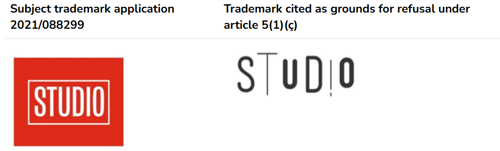
The Court of Cassation upheld the Regional Court of Appeal’s cancellation of the Re-examination and Evaluation Board (REEB)’s decision. Although the marks shared the word element “studio”, their logos, colours and typefaces differed substantially. Those features produced distinct overall visual impressions. Accordingly, the common word element was insufficient to establish identicalness or indistinguishable similarity under article 5(1)(ç).
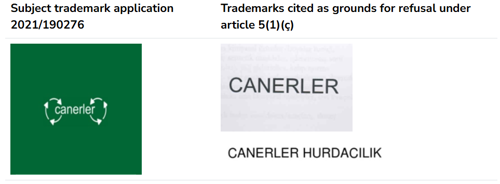
The second decision (merit no 2025/4540, decision no 2026/1659, 25 March 2026) concerned marks incorporating the shared word element “canerler”, as shown below. This dispute also raised the question of whether a common verbal element was sufficient to meet the threshold of indistinguishable similarity when the marks differed in their visual presentation.
Table 2. Decision of 25 March 2026
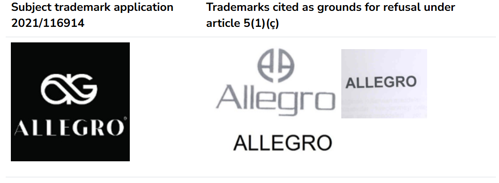
In a third dispute (merit no 2025/6836, decision no 2026/3681, 17 June 2026) illustrated below, the Court of Cassation upheld the Regional Court of Appeal’s cancellation of the REEB’s decision. It found that the contested application and the earlier marks relied upon as grounds for refusal were neither identical nor indistinguishably similar within the meaning of article 5(1)(ç). This decision also underscores the need to assess the marks as presented rather than treating a shared word element as conclusive.
Table 3. Decision of 17 June 2026
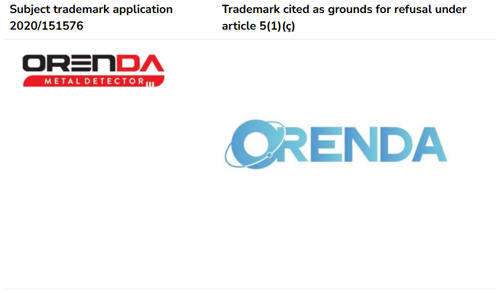
The fourth decision (merit no 2025/3592, decision no 2026/375, 22 January 2026) concerned the REEB’s finding of indistinguishable similarity between the marks shown below. The Court of Cassation upheld the Regional Court of Appeal’s cancellation of that decision, finding that the marks were distinguishable at first glance. In particular, the arrangement of the contested application and its additional word elements, considered alongside the stylised letter “O” in the earlier mark, resulted in sufficiently different overall impressions.
Table 4. Decision of 22 January 2026
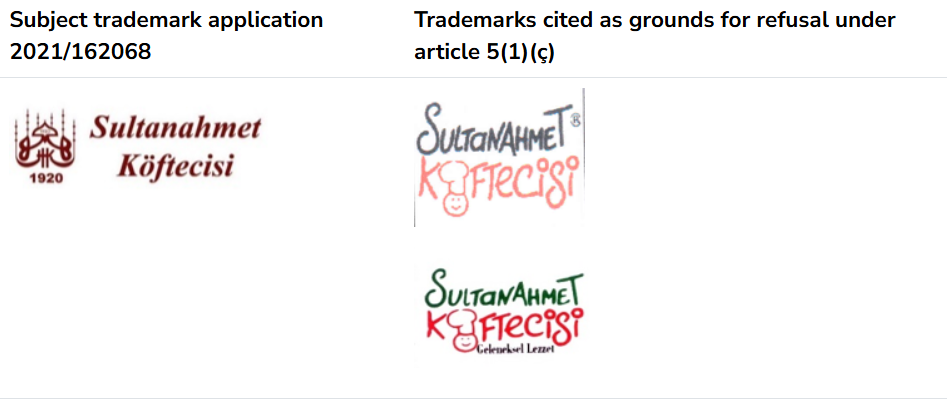
Finally, the fifth decision (merit no 2025/4198, decision no 2026/1070, 25 February 2026) involved marks that reproduced the same expression, “Sultanahmet Köftecisi”, but combined it with different figurative elements. The Court of Cassation upheld the Regional Court of Appeal’s cancellation of the REEB’s decision and reiterated the demanding nature of the standard: the resemblance must be so pronounced and evident that there is no need for a further examination of whether it creates a likelihood of confusion.
Table 5. Decision of 25 February 2026
Key takeaways
Taken together, these five decisions demonstrate that sharing the same word element does not necessarily make two trademarks identical or indistinguishably similar under article 5(1)(ç). Differences in figurative elements, layout, typography and overall appearance may be sufficient to distinguish the marks at first glance. Accordingly, the assessment should focus on the overall impression of the marks rather than solely on their common word elements. While such marks may still be considered confusingly similar, this is a separate question to be assessed under the relevant provisions governing likelihood of confusion.
First published by WTR Market Insight in Nov 05, 2026.